Christmas movie classic, Tokyo Godfathers
I wouldn’t consider myself an anime or animated film person—with the exception of realistic animated movies and shows I grew up watching. But after scrolling tirelessly through recommendation sites and TikTok videos, I stumbled upon Tokyo Godfathers, an animated Japanese film from 2003. Hesitantly, I read the synopsis, and by the end, I wanted to watch the movie immediately.
There’s something about the heartfelt journey of three seemingly lonely people navigating the streets of Tokyo during the warmest and most joyous time of the year that tugged at my heartstrings. It didn’t disappoint one bit; I cried, I laughed, and I learned valuable lessons about family and the true spirit of Christmas. What surprised me, though, was that while I initially thought the plotline and story would captivate me, I came away loving the characters most: Hana, Miyuki, and Gin.
Hana is an ex-drag queen, Gin is an alcoholic father who abandoned his wife and daughter out of shame for losing bets, and Miyuki is a runaway teenager who feels guilty for what she did to her father. Within the first few minutes, the dynamic between the three is clear, with Hana acting as the mediator while Gin and Miyuki constantly bicker, despite their age difference.

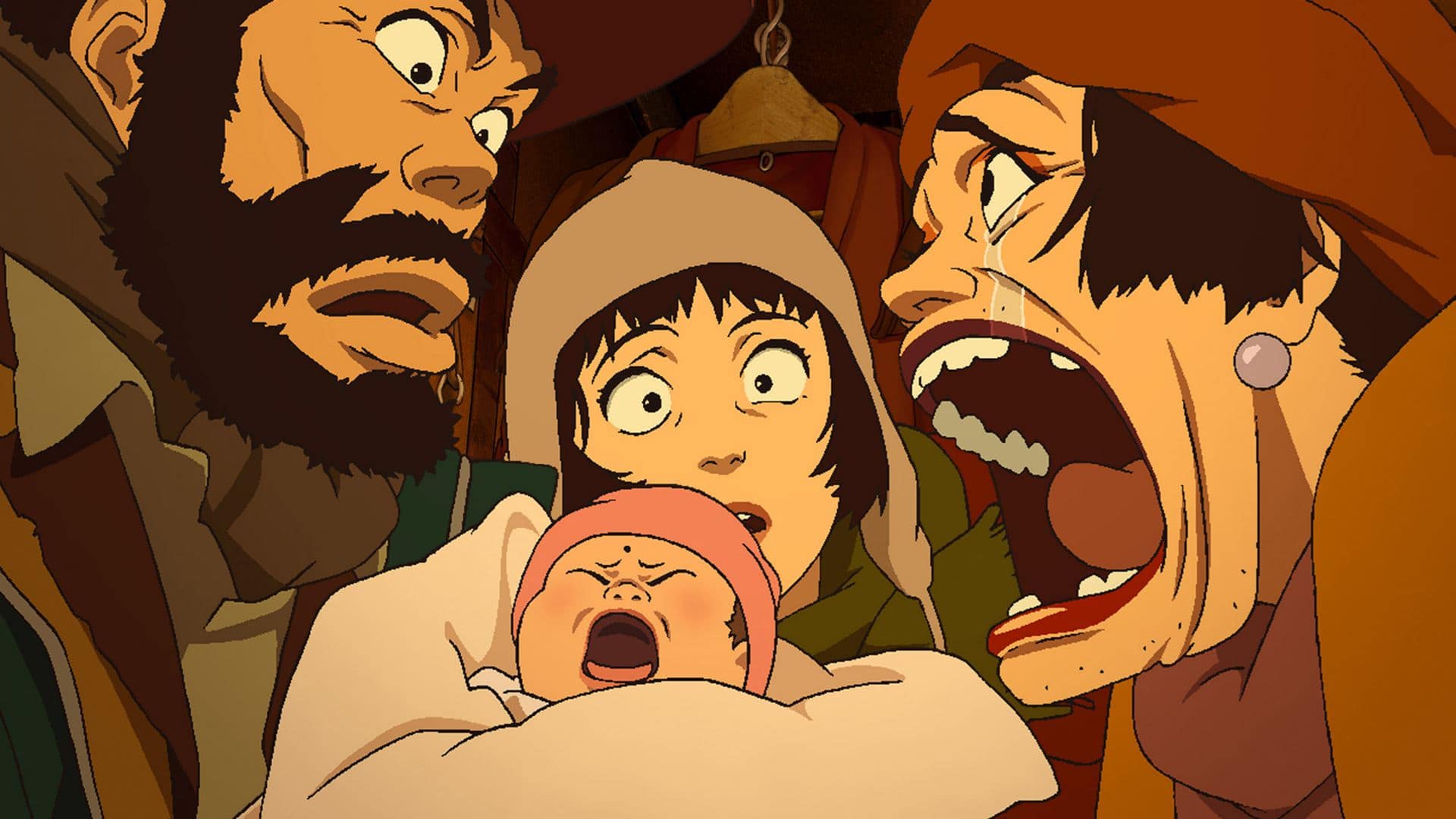
With really nothing but a photograph of the baby’s parents, the trio weaves through the streets of Tokyo, carrying the infant in their arms. While the film’s overarching plot is about the search for Kiyoko’s parents, the true foundation of the story is the backstory of the three protagonists, how they ended up homeless, and their love that grows over time for one another. Through this, the film delves into the sociopolitical landscape of Japanese society—exploring classism, poverty, and gender identity, with the last theme particularly visible through Hana’s experience.
Medical care is used to emphasize class struggle. This is particularly evident when Hana becomes sick, and Gin must use his life savings for her treatment. Hana’s gender identity is subtly highlighted here, as the hospital places her in the men’s ward, much to her displeasure. Though a minor moment, it underscores the very real issue of how medical institutions can oppress trans people. Tokyo Godfathers avoids the typical media rhetoric that hyper-focuses on trans people through medicalized narratives of transitioning, hormones, or surgeries. Instead, it presents Hana as a person with desires and flaws, without reducing her to her gender identity.
Discrimination recurs throughout the film. For instance, Miyuki’s father, a police inspector, expresses disdain when Kiyoko’s parents wish to meet Hana, Gin, and Miyuki to thank them and ask them to be the baby’s godparents. “But they are homeless,” he protests. On a train, passengers cover their noses and complain about the strong smell emanating from unwashed bodies, insinuating the three protagonists.
Despite societal rejection, the trio forms a family—albeit an unconventional one. Their unity stands in stark contrast to the “normal” Japanese family, as seen in one scene where they sit before a billboard depicting the perfect nuclear family. Miyuki, a runaway teenager, starkly contrasts the polished schoolgirls often represented in Japanese media.
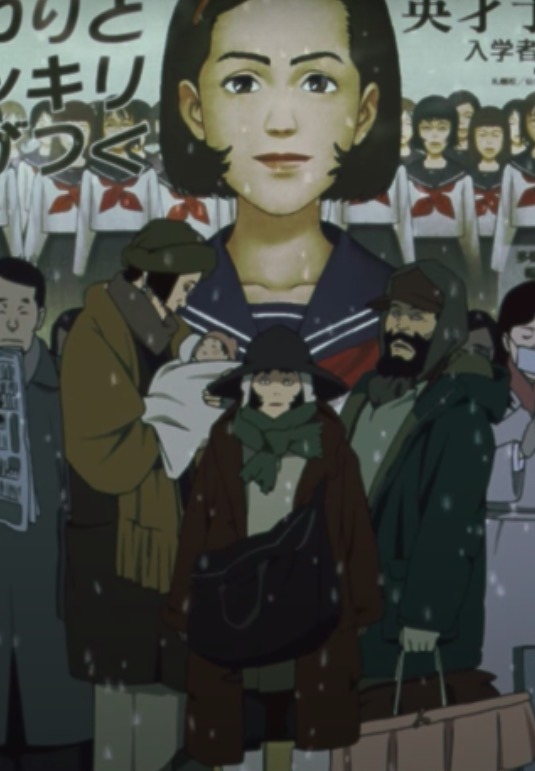
However, though physically unlike one, the dynamics between the characters feel ordinary and mundane, no difference than that of a typical family.
Hana, in particular, feels like the heart of the story—the comedic relief, the leader of their found family, and the one who propels their journey forward. Her insistence on returning the baby to the mother, driven by her longing for love and closure, motivates the entire quest. This goal of her also shift the focus away from her gender identity in a way, and to the goal of love. This instantly humanizes her, that like all of us, regardless of how we identify ourselves, we all yearn for love. Love, being a universal human experience, is used to
One of the most memorable scenes for me is near the end, when Hana holds the baby as they fall from a tall building. A strong gust of wind carries them gently, sunlight breaking through the cold winter sky above the skyscrapers of Tokyo, on the horizon. There is no music, just silent as the two glides through the air downwards. I think there is something so magical and peaceful about this sequence, that the choice of no background music or sounds was something done deliberately. Afterward, the first thing to break this silence is the baby's cries.
The Christmas motifs such as Christmas date and angels scattered throughout the movie add depth.The locker key labeled ‘1225,” the display on the alarm clock, and subtle references to angels create a subdued yet meaningful holiday atmosphere (see if you can find all of the Christmas dates scattered throughout the film!). Angels appear as recurring symbols. Hana names the baby Kiyoko, meaning “pure child,” and frequently refers to her as an angel. Even Miyuki’s cat is named Angel, sporting white patches reminiscent of angel wings. After Gin is beaten by a group of young men, he encounters a drag queen dressed as an angel, offering him the choice between magic and an ambulance. This angelic figure later reappears, suggesting she wasn’t merely a hallucination.
The film’s color palette leans heavily on gray, brown, and white, reflecting the harsh realities of winter and homelessness. Yet, the three protagonist persistence and overtime-fondness of one another (and Hana's optimism) keeps the holiday spirit alive. “This is a Christmas present from God,” she exclaims upon finding the baby. She believes the child to be lucky, attributing to their miraculous survival to divine intervention.
Tokyo Godfathers moved me deeply with its poignant humor, compelling characters, and powerful social commentary. It has earned its place as an instant Christmas classic.

Comments
Post a Comment